
Menopause as a Metabolic Transition
What’s Really Happening to Your Body (And What You Can Actually Do About It)
"I’m doing everything I’ve always done. Same workouts. Same meals. And somehow the weight just keeps creeping up."
Sarah sat across from me, frustrated and exhausted. At 47, she was still running several times a week and eating well, but her body wasn’t responding the way it used to. The scale was up 15 pounds in under two years, mostly around her midsection, and nothing she tried seemed to make a dent.
Her doctor had told her, “It’s just part of aging.”
But deep down, she knew there had to be more to the story.
She was right.
Sound familiar? Let’s unpack what’s really going on.
Why Am I Gaining Weight When I Haven’t Changed Anything?
Here’s what I tell every woman in this season:
You’re not imagining it. You’re not doing anything wrong. And no, this isn’t about willpower.
Menopause is a full-body recalibration, especially for your metabolism. Trying to power through with your old routines often leads to frustration, not results.
Think of it like your body updating its operating system. The hardware isn’t broken, but everything functions a little differently now. You need a new strategy to match.
What’s Actually Changing in My Body?
Two major shifts are happening under the surface.
1. Your Metabolism Slows Down
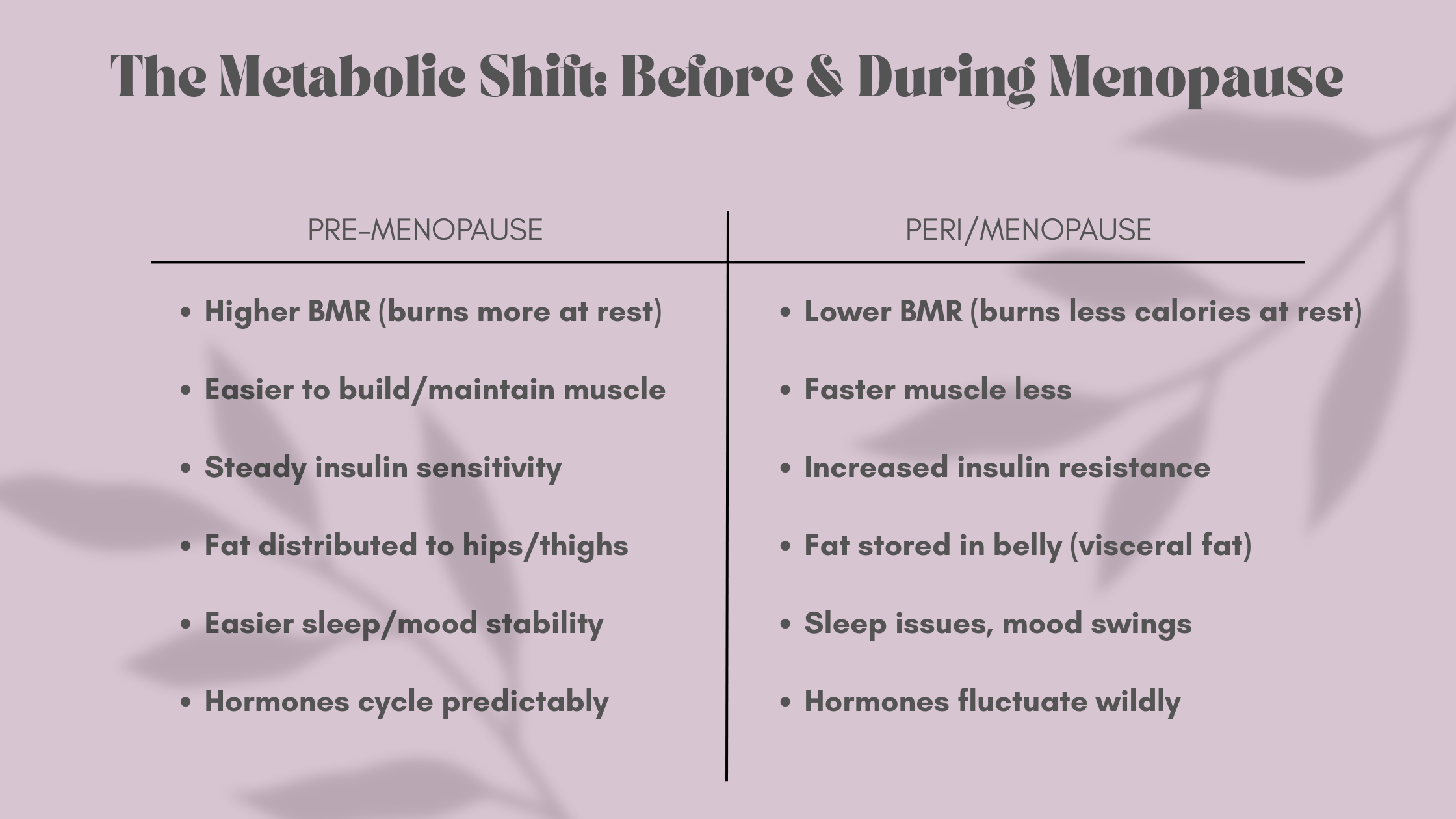
Specifically, your basal metabolic rate (BMR), which is the number of calories your body burns at rest, starts to decline. For some women, this drop can mean burning 200 to 300 fewer calories per day, even if your activity and diet haven’t changed.
That creates a calorie surplus without you realizing it. Over time, this can lead to 1 or 2 pounds of weight gain per month. Even a small change, like an extra 100 calories per day, can add up.
Why this happens:
Estrogen affects energy regulation. When estrogen drops, your body burns fewer calories.
You lose muscle faster. Muscle burns calories, even at rest. As you lose muscle, your BMR drops further.
This is the double whammy of menopause. Hormone changes and muscle loss create a slower metabolism.
2. Your Body Processes Sugar and Fat Differently
Lower estrogen also reduces insulin sensitivity. That means your body becomes less efficient at using carbohydrates for energy and more likely to store them as fat, especially around your middle.
Is This Just Aging or Is It Menopause?
Short answer: both.
Long answer: menopause accelerates metabolic changes more than aging alone.
Yes, aging contributes to gradual weight gain. But during perimenopause, your estrogen and progesterone levels don’t just decline. They fluctuate wildly for years before they stabilize. These hormonal shifts affect sleep, appetite, energy, stress response, and body composition.
So while aging plays a role, menopause is a distinct biological transition that requires a distinct strategy.
Why Is Everything Going to My Belly?
This is one of the most common and frustrating changes women notice.
Estrogen helps regulate fat distribution. When estrogen is higher, fat tends to be more evenly distributed across your hips, thighs, and buttocks. When estrogen drops, your body starts storing more fat in the abdominal area.
This is called visceral fat. It surrounds your organs and is associated with higher risk for chronic conditions like heart disease and insulin resistance.
You might notice:
Your waist thickening even if your weight stays the same
Clothes fitting differently
More bloating and puffiness
A shift in shape without major changes on the scale
This isn’t in your head. It’s hormonal.
Will Hormone Therapy Help With Weight?
This is a great question and an important one to clarify.
Hormone therapy is not a weight loss medication.
It isn’t prescribed for weight management. But it can make weight loss more achievable by improving other symptoms that interfere with healthy habits.
Here’s how it can help:
Better sleep. When night sweats improve, your sleep quality goes up. Better sleep supports hunger regulation and reduces cravings.
Improved mood and energy. You’re more likely to move your body and prepare nourishing meals when you feel like yourself again.
Metabolic support. Some research shows that hormone therapy may help reduce visceral fat accumulation and preserve metabolic rate.
Stress response. Estrogen buffers the effects of stress. Replacing some of that lost estrogen can help reduce cortisol-driven fat storage.
That said, hormone therapy is not the only solution. It’s one tool in a much bigger toolkit. And it works best alongside sleep, movement, nutrition, and stress support.
Can You Actually Lose Weight During Menopause?
Yes. Let me say that again—yes, you can.
Menopause changes how your body responds, but it does not make weight loss impossible. I see women improve their body composition all the time, even in midlife.
Even small amounts of weight loss—about 5 to 10 percent of your body weight—can reduce visceral fat, improve insulin sensitivity, and lower disease risk.
What Actually Works?
Let’s talk about what moves the needle for real.
1. Prioritize Protein and Strength Training
Protein supports muscle maintenance, which is critical for metabolism. Strength training helps preserve and build muscle.
Aim for at least 1.2 to 1.8 grams of protein per kilogram of body weight daily. A 175-pound woman, or about 80 kilograms, would need at least 96 to 144 grams of protein per day, depending on her goals and activity level.
Train all major muscle groups at least 2 to 3 times per week.
2. Move Throughout the Day
Daily activity matters as much as your workouts. Movement like walking, standing, doing chores, and gardening burns energy. When stress and fatigue reduce this movement, it can quietly lower your calorie burn by a few hundred calories per day.
3. Focus on Fiber and Whole Foods
Whole, plant-rich meals help balance blood sugar and improve satiety. Think: vegetables, fruits, healthy fats, legumes, and lean protein.
This isn’t about cutting everything out. It’s about giving your body what it needs.
4. Treat Sleep and Stress as Non-Negotiables
Sleep is essential for regulating hunger hormones and metabolism.
Chronic stress increases cortisol, which can drive fat storage around the belly.
If you’re doing everything “right” but ignoring sleep and stress, the results may not show up.
5. Track What Actually Matters
Instead of obsessing over the scale, look at:
Waist circumference
How your clothes fit
Strength gains
Energy and mood
These are better markers of progress than weight alone.
The Bottom Line
Menopause is a metabolic transition. It is not a metabolic failure.
You’re not broken. Your body is adapting. And when we understand what’s shifting under the surface, we can build a plan that supports it.
If you’ve been told to “just eat less and move more,” I want you to know you deserve better.
With the right strategy, tailored to your biology and life stage, you can feel strong, steady, and confident in your body again.
📩 Want support that actually makes sense?
Join the 2026 Masterclass: Metabolism & Weight Management in Midlife
📞 Ready to take action now? Book a discovery call to get started on a personalized plan that meets your body where it’s at.
You don’t need to do this alone.
You need the right guide, the right tools, and a strategy that works for you.